

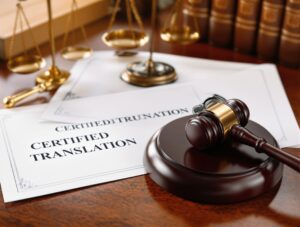
Court Submissions: The Essential Guide to Sworn and Certified Translations
When submitting foreign-language documents as evidence in U.S. courts, accuracy and legal compliance are paramount. Courts require sworn or certified translations to ensure that all parties have access to a precise and legally admissible version of the material (1). Translators may even need to testify or provide an affidavit confirming the translation’s accuracy (2). Additionally, many courts mandate that translators be certified or recognized by a legal body to guarantee professionalism and reliability (3). This includes understanding the requirements for court submissions.
This guide explores the critical aspects of court submissions involving translations, including:
-
Understanding the nuances of court submissions is crucial for effective legal communication.
The difference between sworn and certified translations
-
Legal requirements for court-admissible translations
-
The role of the translator in legal proceedings
-
Best practices for obtaining and submitting certified translations
By understanding these key elements, legal professionals, businesses, and individuals can ensure their documents meet judicial standards.
In summary, mastering the process of court submissions is essential for legal success.
1. What Are Sworn and Certified Translations?
1.1 Sworn Translations
A sworn translation is a legally binding document in which the translator attests, under oath, that the translation is accurate and complete. These translations are often required in court cases, immigration proceedings, and government submissions (4).
Key characteristics:
-
The translator signs a statement of accuracy (affidavit) (5)
-
The document may need notarization (6)
-
Some jurisdictions require the translator to be registered or court-approved (7)
1.2 Certified Translations
A certified translation includes a signed statement from the translator or translation agency confirming that the work is accurate to the best of their knowledge. Unlike sworn translations, certification does not always require an oath but must still meet court standards (8).
Key differences from sworn translations:
-
Often used in administrative and business contexts (9)
-
May not require notarization (varies by jurisdiction) (10)
-
Must include a certificate of accuracy (11)
2. Legal Requirements for Court Submissions
2.1 When Are Certified or Sworn Translations Required?
U.S. courts typically demand certified or sworn translations for:
-
Affidavits and witness statements in foreign languages (12)
-
Contracts, patents, and business records submitted as evidence (13)
-
Immigration documents (e.g., birth certificates, marriage licenses) (14)
Failure to provide an approved translation can result in evidence being dismissed (15).
2.2 Who Can Provide Court-Admissible Translations?
Courts often require translators to be:
-
Certified by the American Translators Association (ATA) or a similar body (1)
-
Registered with a state or federal court (7)
-
Licensed notary publics (for sworn translations) (6)
Some states, like California, maintain official lists of court-certified translators (7).
3. The Translator’s Role in Legal Proceedings
3.1 Affidavits and Testimony
If a translation’s accuracy is challenged, the translator may need to:
-
Submit a notarized affidavit affirming the translation’s correctness (5)
-
Testify in court as an expert witness (2)
3.2 Ethical and Professional Standards
Legal translators must:
-
Maintain confidentiality (8)
-
Avoid conflicts of interest (3)
-
Adhere to industry best practices (e.g., ATA guidelines) (1)
4. Best Practices for Obtaining Court-Admissible Translations
-
Choose a Qualified Translator
-
Look for ATA certification or court-approved credentials (1)
-
Verify experience in legal and technical translations (3)
-
-
Ensure Proper Certification
-
Request a signed certificate of accuracy (11)
-
Confirm if notarization is required (6)
-
-
Submit Translations Correctly
-
Follow court filing guidelines (15)
-
Keep copies of all certified documents (13)
-
Expert Opinion
Legal translation errors can derail cases or lead to costly appeals. Courts prioritize accuracy and adherence to procedural rules, so working with a certified professional is essential. The ATA and state court systems provide valuable resources for finding qualified translators (1, 7).
FAQ
1. What’s the difference between a certified and a sworn translation?
-
A certified translation includes a statement of accuracy (11), while a sworn translation requires an oath and often notarization (6).
2. Can I translate my own documents for court?
-
Generally no—most courts require an independent, certified translator (1, 7).
3. How long does a certified translation take?
-
Typically 1-3 business days, depending on document length and complexity (8).
4. Do all courts accept ATA-certified translations?
-
Most do, but some may require state-specific certification (7).
5. What happens if my translation is rejected?
-
You may need to resubmit with a different certified translator or provide additional affidavits (15).
References
-
American Translators Association. (n.d.). Evidentiary Translation for U.S. Courts. https://www.atanet.org/resources/evidentiary-translation-for-u-s-courts/
-
U.S. Courts. (2023). Federal Rules of Evidence, Rule 604 (Interpreters and Translators). https://www.uscourts.gov/rules-policies/current-rules-practice-procedure/federal-rules-evidence
-
National Association of Judiciary Interpreters & Translators. (2022). NAJIT Certification Standards for Legal Translators. https://najit.org/certification/
-
Judicial Council of California. (2023). Court Interpreters Program: Translation Requirements. https://www.courts.ca.gov/programs-interpreters.htm
-
New York State Unified Court System. (2023). Language Access: Translation Guidelines. https://www.nycourts.gov/courts/nyc/languageaccess/translations.shtml
-
National Notary Association. (2023). How to Notarize a Sworn Translation. https://www.nationalnotary.org/knowledge-center/about-notaries
-
ISO. (2015). ISO 17100:2015 Translation Services—Requirements. https://www.iso.org/standard/59149.html
-
U.S. Department of Justice. (2022). Language Access in Federal Courts. https://www.justice.gov/language-access
-
Administrative Office of the U.S. Courts. (2023). Federal Court Interpreter Certification Exam (FCICE). https://www.uscourts.gov/services-forms/federal-court-interpreters
-
American Bar Association. (2021). ABA Standards for Language Access in Courts. https://www.americanbar.org/groups/public_services/
-
Texas Department of Licensing and Regulation. (2023). Court Interpreter Certification. https://www.tdlr.texas.gov/court/interpreters.htm
-
U.S. Citizenship and Immigration Services. (2023). Certified Translation Requirements. https://www.uscis.gov/forms/forms-information/form-filing-tips
-
European Commission. (2022). Sworn Translation Requirements in EU Member States. https://ec.europa.eu/info/resources-partners/translation_en
-
California Courts. (2023). Official List of Court-Certified Translators. https://www.courts.ca.gov/documents/spn100.pdf
-
American Translators Association. (2023). ATA Certification Program Handbook. https://www.atanet.org/certification/ata-certification/